Rootstock
Rootstock is a Python library that lets you run many machine-learned interatomic potentials (MLIPs) on an HPC cluster from a single ASE-compatible calculator. Each MLIP family runs in its own pre-built, isolated Python environment that a maintainer has already installed and verified on the cluster, so you never resolve conflicting Python or library versions yourself. Swapping models is a one-line change to the checkpoint argument.
How do I use Rootstock?
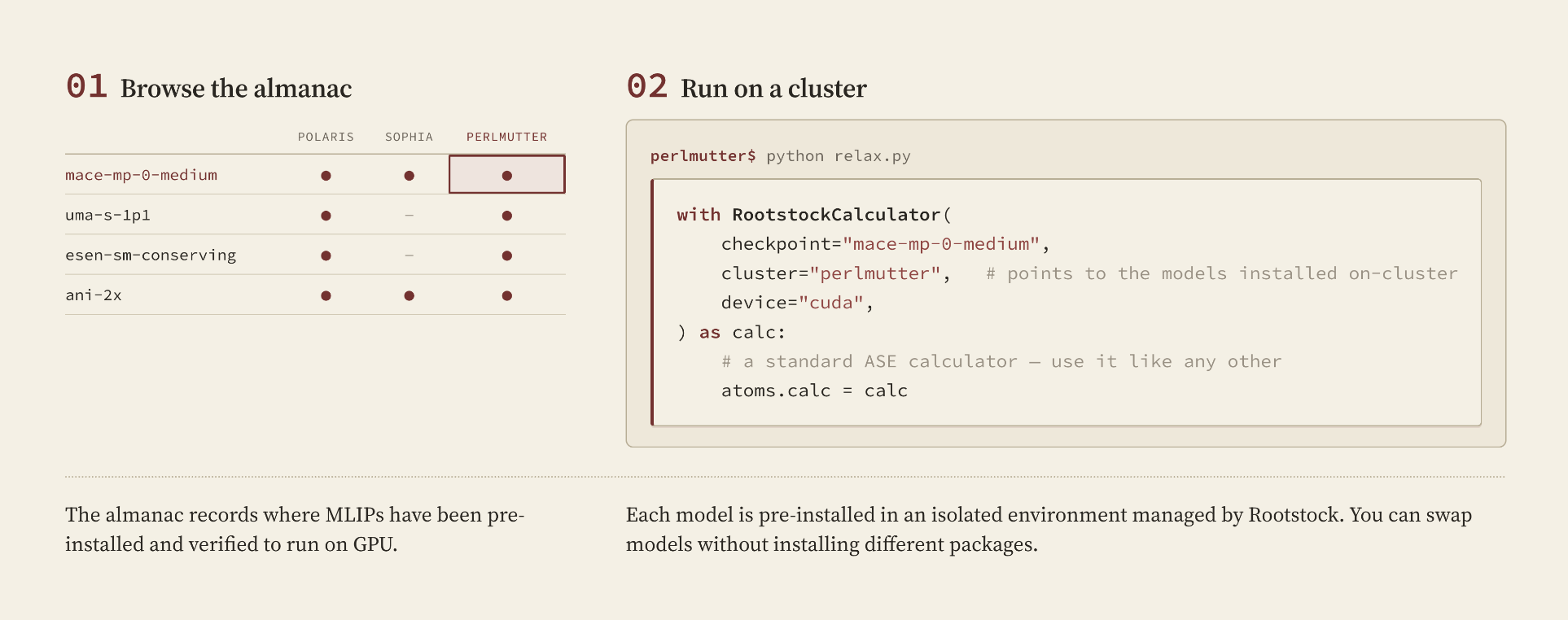
Browse the Matter Model Almanac to find a model that is installed and verified on your cluster, then point a RootstockCalculator at it. Each model is already installed in an isolated environment, so changing models does not change your own environment.
How does Rootstock run a model?
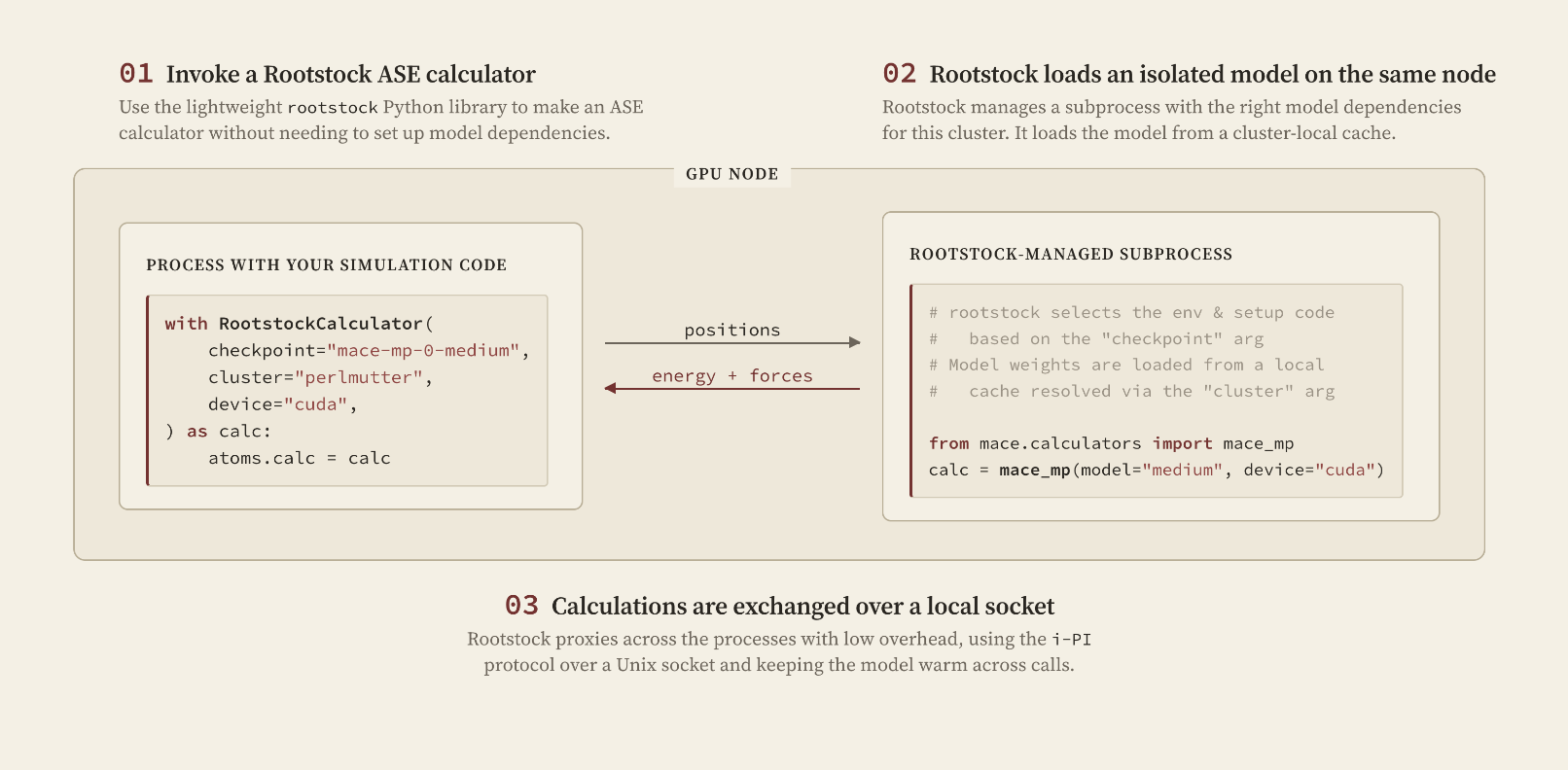
You call the calculator from the lightweight rootstock library, which carries no model dependencies. Rootstock starts the model in a managed subprocess on the same GPU node, in the environment built for that cluster, loading weights from a cluster-local cache. Positions and forces are exchanged over a local Unix socket using the i-PI protocol. The model is loaded once and kept warm across calls.
How does Rootstock add models?
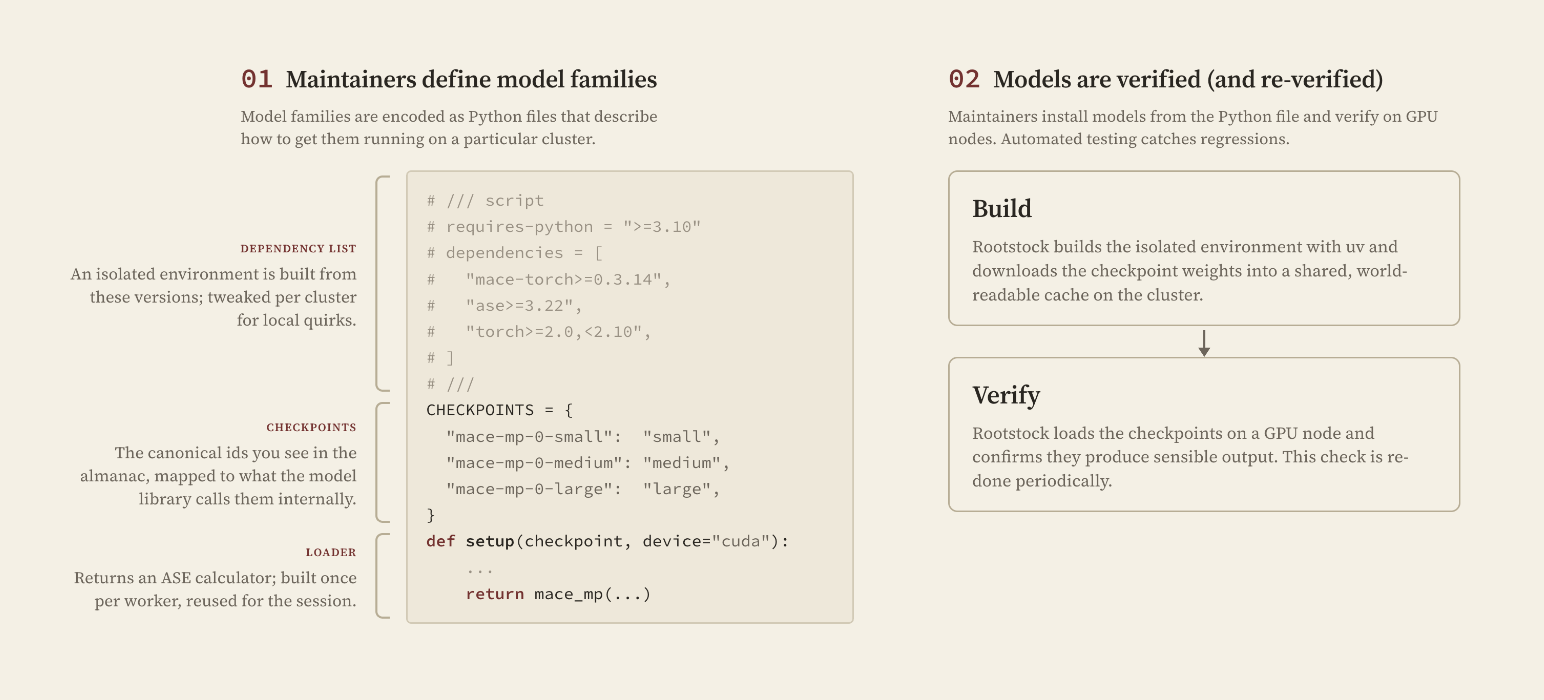
Maintainers define each model family as a Python file: a PEP 723 dependency list, a declaration of CHECKPOINTS in this family, and a setup() loader that returns an ASE calculator. They build the isolated environment and verify it on a GPU node. Automated testing re-verifies checkpoints periodically to catch regressions.
How to run
-
Run — with Python and ASE
The main path: install the package and call
RootstockCalculatorfrom an ASE script. -
Run — from other tools
Use a Rootstock-hosted model from any tool that accepts an ASE calculator.
-
Run — with agents
Let a coding agent discover what's deployed and drive Rootstock for you.