How does a RootstockCalculator work?
This page explains how Rootstock runs a model at runtime, from the RootstockCalculator in your script down to the worker subprocess.
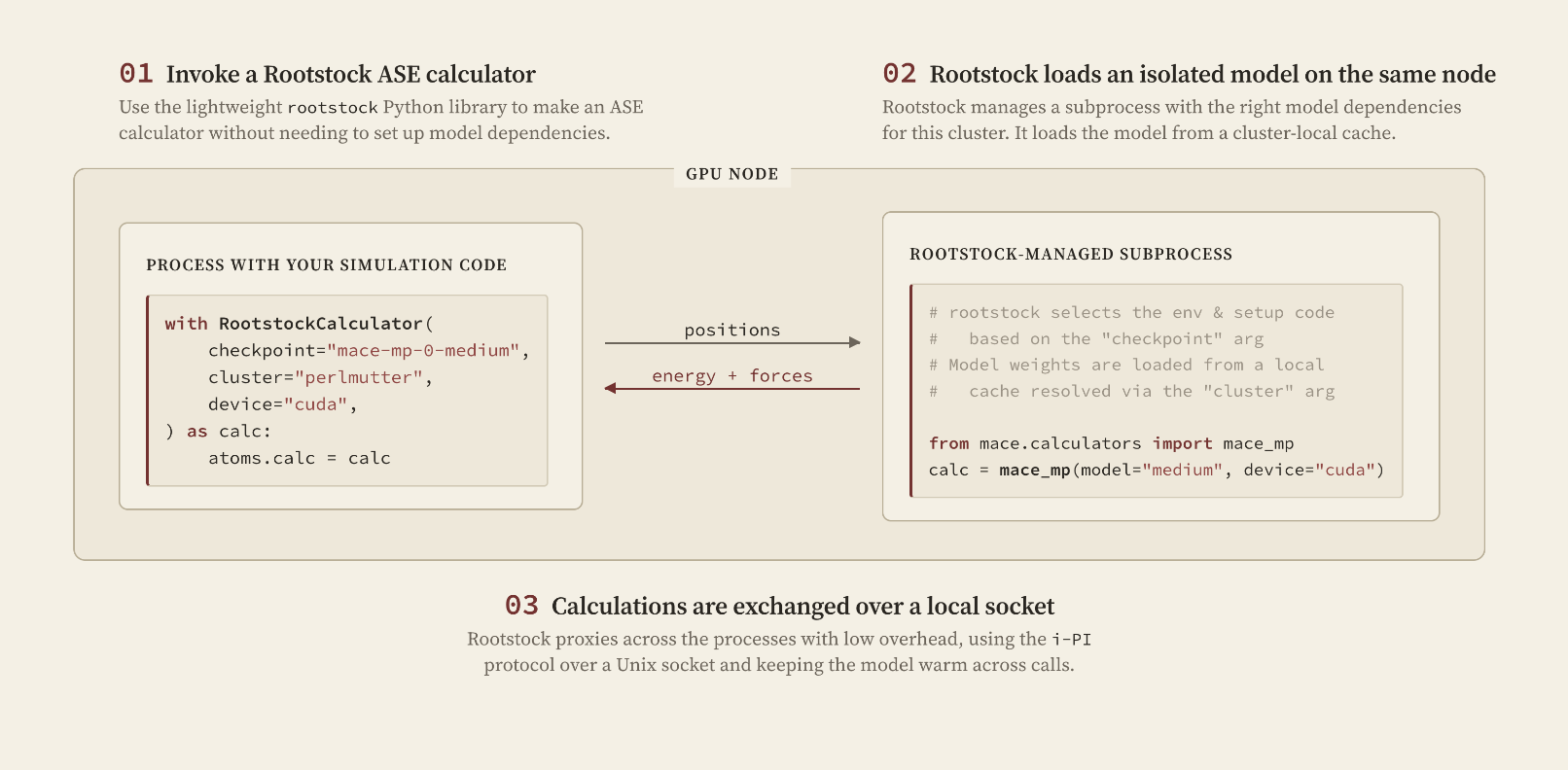
Overview
When you create a RootstockCalculator, Rootstock spawns a worker subprocess that runs the MLIP in its own pre-built virtual environment on the same node. Your own environment only needs the lightweight rootstock package, not the model's dependencies. The two communicate over a Unix domain socket using the i-PI protocol: the i-PI server (server.py) runs inside your process and drives the exchange, while the worker subprocess (worker.py) is the i-PI client that runs the forward pass. All communication is local to one node; there are no remote network calls.
The worker loads the model once and keeps it warm, so repeated calls reuse the loaded weights.
Design benefits
Each MLIP runs in its own isolated environment with its exact dependencies. This removes version conflicts between models, including models that require incompatible Python or library versions. You can swap models in one line, change checkpoint="mace-mp-0-medium" to checkpoint="uma-s-1p1", and use several models sequentially in the same script.
Tradeoffs
Inter-process communication adds a small cost. On an 864-atom system the overhead is about 4%. Positions and forces are serialized with the i-PI protocol and pass over a local Unix domain socket. For most workloads this is negligible next to the MLIP forward pass.
i-PI protocol
Rootstock uses the i-PI protocol for communication between the main process and worker:
- Main process sends atomic positions and cell parameters
- Worker receives positions and runs the MLIP forward pass
- Worker sends back energy, forces, and stress
- Main process receives results and returns them to ASE
Commands are 12-byte ASCII strings; payloads are raw numpy buffers in
atomic units, following ASE's ase.calculators.socketio implementation.
Deviations from standard i-PI
Rootstock speaks a private dialect of the i-PI protocol. The wire framing is standard, but the semantics deviate in two load-bearing ways. Read this before trying to point any other i-PI implementation at a rootstock worker.
The INIT payload is required, and it is JSON. Standard i-PI transmits only geometry (cell and positions); a force engine is expected to already know its chemical species from its own input. A rootstock worker hosts a generic ASE calculator and knows nothing about the system at spawn time, so the server packs the species into the INIT message's free-form init string as UTF-8 JSON:
A worker that has not received this payload fails at the first POSDATA. Unknown keys in the JSON object are ignored, which makes new keys a sanctioned forward-compatible extension channel.
The info object carries the JSON-serializable subset of the client's
atoms.info — model inputs like charge, spin, and external_field
that OMol-era and POLAR checkpoints read at calculate-time. The worker
applies it to its Atoms each cycle (numeric vectors become numpy arrays);
the calculator drops non-serializable values with a debug log.
The worker demands INIT before every force evaluation. After each
FORCEREADY the worker returns to NEEDINIT rather than READY, and the server
re-sends the JSON INIT every cycle. This is how composition and PBC changes
propagate mid-run (e.g. LAMMPS fix gcmc alongside fix rootstock).
Consequences:
- A standard i-PI server — i-PI itself, ASE's
SocketIOCalculator, or any other implementation — cannot drive a rootstock worker: it won't send the JSON INIT payload, so the worker aborts at the first force request. - The supported protocol peers are exactly
RootstockServer(the ASE calculator path androotstock serve's counterpart) andlammps/fix_rootstock.cpp(which implements the dialect natively, including the per-cycle INIT).fix_rootstockdoes not send theinfoobject, so LAMMPS-driven runs cannot carrycharge/spin/external_field— the worker sees an empty info and the model uses its defaults. - This is a deliberate, documented limitation of 1.0. The worker side of the protocol is frozen inside every built environment, so the requirement cannot be relaxed for environments that have already been deployed.
Worker environment variables
The worker process reads a few ROOTSTOCK_* environment variables once at
startup, into a frozen config object (rootstock/worker_config.py).
Because every built env pins its own copy of rootstock, the worker code
inside an env cannot be updated without a rebuild — environment variables
set at spawn are the one configuration channel that always reaches
already-deployed workers, and worker_config.py is deliberately small,
stdlib-only, and never-fatal on bad input, since it freezes along with the
rest of the worker surface.
| Variable | Default | Description |
|---|---|---|
ROOTSTOCK_WORKER_CONNECT_RETRIES |
50 |
Connection attempts to the server socket |
ROOTSTOCK_WORKER_CONNECT_RETRY_DELAY |
0.1 |
Seconds between connection attempts |
ROOTSTOCK_WORKER_LOG |
unset | Worker log destination when the client didn't attach one: stderr, stdout, or a file path (appended) |
Invalid values fall back to the defaults rather than killing the worker.