Adding Models
A model family is made available to Rootstock through an environment file: a small Python file that pins the model's dependencies in an isolated virtual environment and exposes a setup() that returns an ASE calculator. One file covers a whole family — every checkpoint it lists.
These files are written once per family and kept as working samples in the Rootstock repo, under sample_model_configurations/. Samples are grouped by hardware target (currently nvidia_configs, amd_configs, and aurora_configs for Intel GPUs).
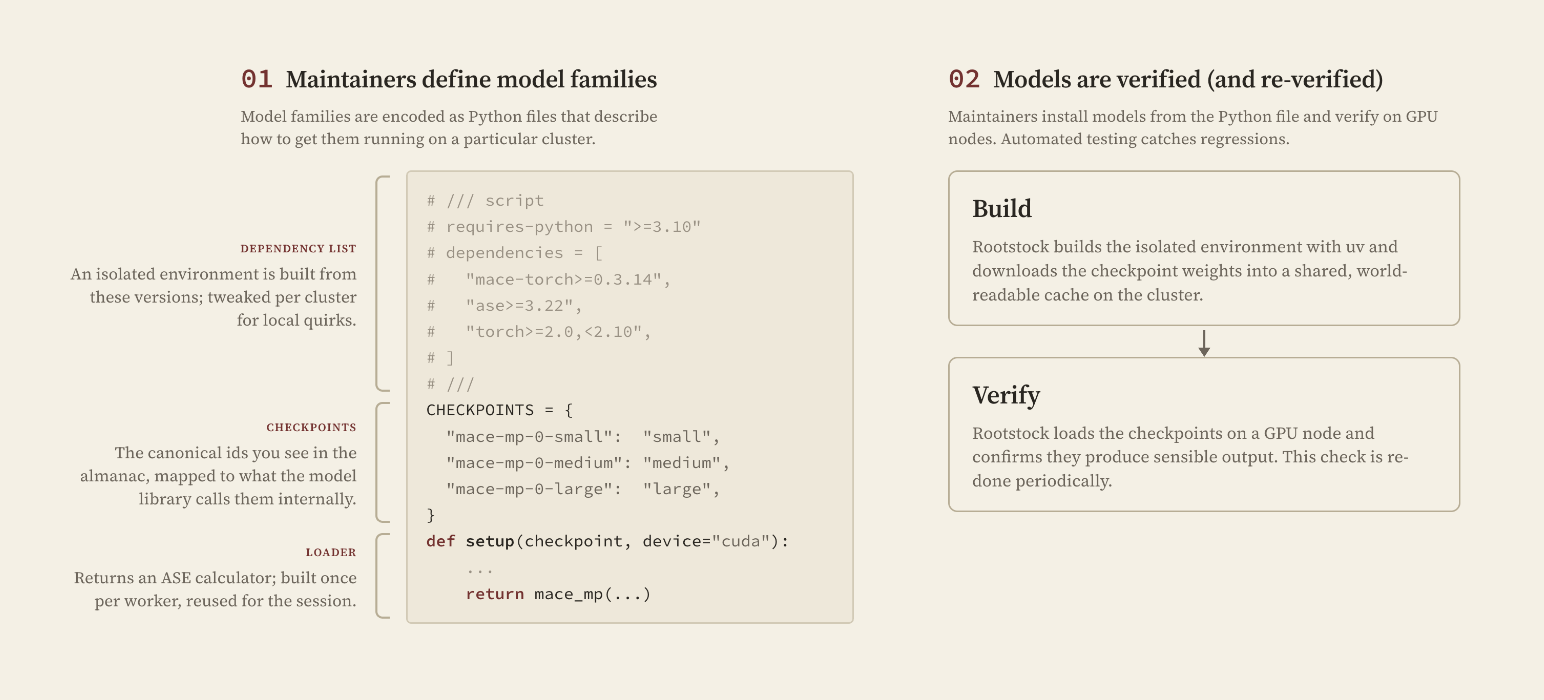
The flow
Adding a model to a cluster is usually a copy-and-adapt job, not authoring from scratch:
- Start from a sample. Copy the matching
<mlip>.pyfrom the repo onto the cluster. (Authoring a brand-new family is the exception — see Writing a file from scratch.) - Build and verify. Run
rootstock install <mlip>.py, thenrootstock add <checkpoint-id>to download a checkpoint and verify it with a forward pass on a GPU node. - Adapt to the cluster. Clusters differ — driver and CUDA versions, the available Python, filesystem quirks — so expect the first verify to surface something. Adjust the dependency pins or
setup()until it passes, and keep the working file. This iteration is the normal case, not a rare one.
An environment file has three pieces:
- A PEP 723 inline metadata block declaring the venv's dependencies.
- A module-level
CHECKPOINTS: dict[str, str]table mapping canonical checkpoint ids to whatever string the upstream library expects. A canonical id is the slug used inrootstock add <id>andRootstockCalculator(checkpoint=<id>); the Matter Model Almanac registers the same ids so its matrix can join to them. - A
setup(checkpoint, device, ...)function that looks the id up inCHECKPOINTSand returns an ASE calculator.
Writing a file from scratch
When no sample exists for a model family yet, scaffold a fresh file:
# Scaffold a template in the current directory
rootstock new-env mace

# Specify custom output path
rootstock new-env mace -o ./environments/mace.py

# Overwrite existing file
rootstock new-env mace --force
The generated file has a placeholder CHECKPOINTS dict and a setup() skeleton. Fill in the dependencies, populate CHECKPOINTS, and implement setup() — the rest of this page describes what goes in each piece. Once it works, contribute it back as a sample so the next cluster can copy it.
Basic structure
# /// script
# requires-python = ">=3.11"
# dependencies = ["mace-torch>=0.3.14", "ase>=3.22", "torch>=2.0,<2.10"]
# ///
"""MACE env — hosts MACE-MP-0 checkpoints."""

CHECKPOINTS = {
    "mace-mp-0-small":  "small",
    "mace-mp-0-medium": "medium",
    "mace-mp-0-large":  "large",
}


def setup(checkpoint: str, device: str = "cuda", **kwargs):
    from mace.calculators import mace_mp
    kwargs.setdefault("default_dtype", "float32")
    return mace_mp(model=CHECKPOINTS[checkpoint], device=device, **kwargs)
How it works
- PEP 723 metadata. Rootstock uses
uvto build an isolated venv from the listed dependencies. CHECKPOINTStable. This is the env's local dispatch table. The keys are canonical ids; the Almanac registers the same ids as its join key. The values are whatever the upstream library wants — a short name, a HuggingFace path, a function name, anything.setup(checkpoint, device, **kwargs). Called once when a worker starts. The returned calculator is reused for all calculations in that session. Forward**kwargsto the calculator constructor — it's the user escape hatch (setup_kwargs=/--kwarg) for constructor knobs the env doesn't name explicitly. For a default the env wants to set itself (likedefault_dtypeabove), usekwargs.setdefault(...)so a user override doesn't collide with the named argument. The same applies tosetup_from_path(path, device, **kwargs).
When a user runs rootstock add mace-mp-0-medium, Rootstock walks every installed env's env_source.py, AST-parses the CHECKPOINTS literal, and finds the env that declares the id. A typo errors immediately ("no installed env declares ..."), instead of failing inside setup().
Lockfiles and reproducible rebuilds
The PEP 723 block declares version ranges; the exact package set is resolved once, at build time. rootstock install records that resolution in a uv lockfile so a rebuild reproduces the env instead of re-resolving whatever the ranges allow that day:
{root}/environments/<name>.py.lock— the working lockfile, next to the registered source.uv lock --scriptwrites it on first build and keeps its pins on later builds.{root}/envs/<name>/env_source.py.lock— a copy stored inside the built env, recording exactly what that build was resolved from. Its hash is tracked in the manifest aslock_hash.
Rebuilds (rootstock install <name> --force) install exactly the locked versions by default. Two things change the resolution:
- Editing the env source. Changed constraints re-resolve minimally; pins that still satisfy the ranges are kept.
rootstock install <name> --force --upgrade. Re-resolves everything to the latest allowed versions. Use this when you deliberately want a fresh stack.
Not every env can be locked. uv lock resolves for every platform at once, so an env pulling prebuilt wheels from a platform-specific index (e.g. the PyG find-links pages used by the fairchem-core 1.x configs have no macOS wheels) fails universal resolution. install warns and builds it without a lockfile.
NOTE: rootstock is not included in the lockfile. The lockfile is only for the dependencies declared in the script metadata, and rootstock itself is installed directly into the env after the env has been (re)built. This means that a rootstock install --force (without --upgrade) will always install whatever version of rootstock is being used for the install command, NOT the version that was already in the env.
Required elements
PEP 723 metadata block
# /// script
# requires-python = ">=3.11"
# dependencies = [
#     "mace-torch>=0.3.14",
#     "ase>=3.22",
#     "torch>=2.0,<2.10"
# ]
# ///
requires-python: Minimum Python version.dependencies: Pip-installable packages with version constraints.
Non-CUDA GPUs need their PyTorch wheel from a hardware-specific index, pinned in the same PEP 723 block via [tool.uv.sources] + [[tool.uv.index]] (honored because install uses uv sync --script). AMD uses the ROCm index; Intel/Aurora uses the XPU index:
# dependencies = [
#     "mace-torch>=0.3.15", "ase>=3.22",
#     "torch>=2.13",   # older XPU wheels have much slower FP64 kernels
#     "triton-xpu",    # torch's XPU dep; direct so the explicit index routes it
# ]
#
# [tool.uv.sources]
# torch = { index = "pytorch-xpu" }
# triton-xpu = { index = "pytorch-xpu" }
#
# [[tool.uv.index]]
# name = "pytorch-xpu"
# url = "https://download.pytorch.org/whl/xpu"
# explicit = true
Then setup() takes device="xpu". See aurora_configs/{mace,uma,esen,allscaip}.py for complete examples (the FairChem envs install fairchem-core from a fork with native XPU support — PyPI releases accept only cpu/cuda — and force FP64 inference). PyTorch's XPU build ships its Intel runtime under the env's lib/, which the worker adds to LD_LIBRARY_PATH automatically.
CHECKPOINTS table
Module-level, both keys and values must be string literals. Rootstock AST-parses this — it is read without executing the module.
If the upstream string already happens to be a clean canonical id, the mapping is identity:
setup() function
Signature: setup(checkpoint: str, device: str = "cuda", **extra).
checkpoint: Canonical id; must be a key ofCHECKPOINTS.device: PyTorch device.- Optional extra kwargs are forwarded from
RootstockCalculator(setup_kwargs=...)androotstock add --kwarg KEY=VAL.
A kwarg that selects among a model's task heads (UMA's task, MACE-MH-1's
head) should be required, not defaulted: give it a None default and
raise a ValueError naming the valid choices when it's missing. A silent
default head means users unknowingly compute with the wrong physics.
Declare VERIFY_KWARGS (below) so verification still runs without user input.
Return: an ASE-compatible calculator.
setup_from_path() function (optional — enables custom checkpoints)
Declaring a module-level setup_from_path opts the env into custom
checkpoints: user-supplied weights files (e.g. fine-tunes) run via a
"<family>:custom": None entry in CHECKPOINTS plus weights= (or
--weights on the CLI). Declare one entry per user-facing model family —
a multi-family env declares several (e.g. mace-mp:custom and
mace-off23:custom), all routing to the same hook. The entry and the hook
must arrive together: the install lint rejects an entry without the hook,
and envs without an entry don't advertise or accept user weights — the
calculator fails at construction with a clear error. Like CHECKPOINTS,
presence is detected by parsing the source — the module is not executed.
Signature: setup_from_path(path: str, device: str = "cuda", **extra).
path: Absolute filesystem path to the weights file. Loading a file is usually a different upstream call than loading a registry name — e.g. FAIRChem'sload_predict_unit(path)vsget_predict_unit(name)— which is why this is a separate function rather than a path-shapedcheckpoint.device, extra kwargs: as forsetup(). Give extras defaults where a default is correct for any weights file; a head-selection kwarg should default toNoneand be forwarded — the upstream library errors when the fine-tune actually needs one, and users pass it viasetup_kwargs=/--kwarg(it forwards tosetup_from_path()for:customcheckpoints).
Return: an ASE-compatible calculator.
def setup_from_path(path: str, device: str = "cuda", task: str | None = None):
from fairchem.core import FAIRChemCalculator
from fairchem.core.units.mlip_unit import load_predict_unit
predictor = load_predict_unit(path, device=device)
return FAIRChemCalculator(predictor, task_name=task)
The hook is checked against the built env's env_source.py at calculator
construction, so a rebuild (rootstock install --force) from a source that
dropped setup_from_path fails immediately with a maintainer-facing hint —
never as an opaque error inside the worker.
CLUSTERS list (optional — cluster-specific variants on shared installs)
Some installs serve more than one machine (sophia and polaris mount the same
Eagle root). When an env runs on one of them but not the other — different
node image, different driver stack — declare a variant: a second env file
with the same canonical ids, different pins or setup(), and a module-level
Resolution is cluster-aware: on the clusters a variant lists, it beats the
unrestricted env for the ids both declare; every other cluster keeps the
original untouched. Users pass cluster="polaris" (which they already do) and
get the right env; root=-only construction resolves unrestricted envs and
asks for a cluster when only variants declare an id. The two envs share
downloaded weights automatically — the cache is keyed by checkpoint, not env.
smoke-test and the pushed manifests follow the same per-id resolution
(checkpoint-first): on the variant's clusters, each overridden id is tested
via the variant and listed under it in that cluster's manifest — the
universal env's copy is shadowed there, never reported as a permanently
failing row. Ids the variant doesn't declare keep resolving to (and being
tested via) the universal env. Restricting the original with
CLUSTERS = ["sophia"] is only needed in the rare case where every id it
declares is broken on a machine and the variant doesn't cover them all.
Absent CLUSTERS (the normal case) means the env serves every cluster its
install does. Like CHECKPOINTS, the list is AST-parsed — string literals
only, and an empty list is an authoring error.
VERIFY_KWARGS dict (optional — verification kwargs for required-selection envs)
When setup() requires a kwarg (a task-head selection with no default),
verification needs a way to pick one: rootstock smoke-test and a bare
rootstock add call setup() with no extra kwargs, and would otherwise fail
on exactly the error the requirement exists to raise. Declare a module-level
VERIFY_KWARGS = {
"uma-s-1p1": {"task": "omat"},
"uma:custom": {"task": "omat"}, # the weights= smoke-test leg needs one too
}
keyed by canonical checkpoint id (:custom entries included — the nightly
weights= leg re-loads a shipped checkpoint's weights through
setup_from_path() and compares against that checkpoint's baseline, so give
both the same selection). Values are literal dicts of setup kwargs, AST-parsed
like CHECKPOINTS — no names or calls.
Verification-only: explicit kwargs (rootstock add --kwarg ...) always win,
and RootstockCalculator never reads it — users still select explicitly.
Checkpoints without an entry verify with no extra kwargs, so most envs never
declare this.
Examples
MACE (MP-0 and OFF23 in one env)
MACE-MP-0 and MACE-OFF23 ship in the same mace-torch package, so they share a single env. The off: prefix on the upstream string in CHECKPOINTS routes to mace_off() instead of mace_mp() — a small dispatch in setup().
# /// script
# requires-python = ">=3.11"
# dependencies = ["mace-torch>=0.3.0", "ase>=3.22", "torch>=2.4.0,<2.10"]
# ///
"""MACE env — hosts MACE-MP-0 and MACE-OFF23 checkpoints."""
CHECKPOINTS = {
"mace-mp-0-small": "small",
"mace-mp-0-medium": "medium",
"mace-mp-0-large": "large",
"mace-off23-small": "off:small",
"mace-off23-medium": "off:medium",
"mace-off23-large": "off:large",
}
def setup(checkpoint: str, device: str = "cuda"):
arg = CHECKPOINTS[checkpoint]
if arg.startswith("off:"):
from mace.calculators import mace_off
return mace_off(model=arg[4:], device=device, default_dtype="float32")
from mace.calculators import mace_mp
return mace_mp(model=arg, device=device, default_dtype="float32")
UMA (FAIRChem)
UMA is multi-task: setup() requires an explicit task and errors without
one. Users pass setup_kwargs={"task": "omol"} to RootstockCalculator, or
--kwarg task=omol to rootstock add; VERIFY_KWARGS picks the head for
verification.
CHECKPOINTS = {
    "uma-s-1p1": "uma-s-1p1",
}
UMA_TASKS = ("omat", "omol", "oc20", "odac", "omc")
VERIFY_KWARGS = {
"uma-s-1p1": {"task": "omat"},
}
def setup(checkpoint: str, device: str = "cuda", task: str | None = None):
from fairchem.core import FAIRChemCalculator, pretrained_mlip
if task is None:
raise ValueError(
f"{checkpoint} is multi-task and has no default head - select one "
f'with setup_kwargs={{"task": ...}}: one of {", ".join(UMA_TASKS)}'
)
predictor = pretrained_mlip.get_predict_unit(CHECKPOINTS[checkpoint], device=device)
return FAIRChemCalculator(predictor, task_name=task)
TensorNet (MatGL via HuggingFace)
The upstream string is a HuggingFace path; the canonical id is a short slug.
CHECKPOINTS = {
    "tensornet-matpes-pbe-2025-2": "materialyze/TensorNet-PES-MatPES-PBE-2025.2",
}


def setup(checkpoint: str, device: str = "cuda"):
    import matgl
    from huggingface_hub import snapshot_download
    from matgl.ext.ase import PESCalculator

    local_path = snapshot_download(repo_id=CHECKPOINTS[checkpoint])
    return PESCalculator(potential=matgl.load_model(local_path))
Best practices
Pin dependency versions
# Good: pinned
# dependencies = ["mace-torch>=0.3.14,<0.4", "torch>=2.0,<2.10"]

# Avoid: unpinned
# dependencies = ["mace-torch", "torch"]
Ranges bound what a fresh resolution may pick; the lockfile (see Lockfiles and reproducible rebuilds) pins everything for future rebuilds.
Match canonical ids to the Almanac
The canonical ids in CHECKPOINTS are the join key with the Almanac. If the Almanac registers mace-mp-0-medium and you ship a CHECKPOINTS key of mace_mp_0_medium, the two never join and no row in the matrix lights up. Match the registered id exactly. The Almanac is the registry of canonical ids; this env file is the local dispatch.
Serve time must not write to the shared install
rootstock add (run by a maintainer, who can write the shared cache) is when weights download; after that, setup() runs as arbitrary users who can only read the install. So setup() must not write under the shared root on a warm cache — no lock files, no re-downloads, no "touch to check". Libraries that take a write-lock even on cache hits (e.g. cached_path, which orb-models uses) break this: hand them a local file path instead of a URL, pre-fetching the file into $XDG_CACHE_HOME yourself — see nvidia_configs/orb.py. Runtime scratch (compiled kernels, config dirs) is already redirected per-user by rootstock; this rule is about what your setup() and its libraries do with model files.
Expect cluster-specific edits
The same model rarely drops onto every cluster unchanged. Driver and CUDA versions, the available Python, and filesystem behavior all vary, so adapting a sample's dependency pins or setup() for a given cluster is routine, not exceptional. A file can also declare a strict subset of the canonical ids the standard sample carries — keys it doesn't list simply won't resolve to it, and rootstock add finds the right env for each id.
When an entire hardware class needs a different dependency stack (a non-NVIDIA GPU, say), that belongs in its own sample folder alongside nvidia_configs/, rather than as a one-off edit to an existing file. When two machines share one install and only one of them needs the different stack, ship a variant env with a CLUSTERS restriction instead — see CLUSTERS list.
A setup()-only fix to an env that is already deployed does not require a rebuild at all — see Hotfixing setup() without a rebuild.